Issue 3: Vedic Inoculations and the Speckled Monster Virus [Part 2 of 2]
In Part I of this issue we had promised:
“In the next instalment, we will see how smallpox ravaged the entire World, how the West finally accepted being inoculated, and how India continued to use inoculation to prevent serious epidemics of smallpox. “
We shall now proceed.
THE SPECKLED MONSTER RAMPAGED ON… BUT HUMANITY FINALLY WON
Smallpox raged globally for centuries, beginning possibly 10,000 years BCE, (see Part I of this issue), and finally meeting its end in 1979.
“Smallpox represents both the acme of man’s efforts to combat infectious diseases and one of his greatest fears. The disease emerged in prehistoric times to spread throughout the world causing blindness and death in millions of people.”
(Ref. 11)
“The earliest evidence of skin lesions resembling those of smallpox is found on the faces of mummies from the time of the 18th and 20th Egyptian Dynasties (1570 to 1085 BC) and in the well-preserved mummy of Ramses V, who died as a young man in 1157 BC (4-6).”
Smallpox made no distinctions. It affected all ages and socioeconomic classes. It killed Roman Emperor Marcus Aurelius in AD 180.
(Ref. 2)
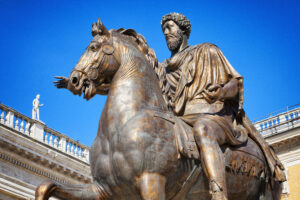
Equestrian Statue of Marcus Aurelius at Palazzo del Campidoglio in Rome, Italy. The original was erected ca. 175 AD by artist unknown, a replica made in 1981 now stands in its place. Source: iStock by Getty Images
Smallpox swept aggressively through the Roman Empire, mainly affecting coastal towns through spread with maritime traders. Called the “ANTONINE PLAGUE”, it brought about the deaths of 150, 000 subjects in Rome itself, and about 7- 8 million across the entire stretch of Empire.
“Given the symptoms described by Galen, there is little doubt it was smallpox.”
(Ref. 4)
In a 400 year span from 1368-1774, smallpox killed more than 20 Kings and/or Queens in empires and kingdoms around the world- ENGLAND, FRANCE, SPAIN, SWEDEN, RUSSIA, MEXICO, JAPAN, CHINA, BURMA, CEYLON, and entire succession orders were wiped out, (Ref. 28).
“During the 18th century, four reigning European monarchs died of the disease, and the Habsburg line of succession to the throne changed four times in four generations because of the deaths of heirs (2).”
(Ref. 2)
Catherine the Great of Russia, horrified by the ugliness of her fiancé after his recovery from smallpox, went to the extent of having him murdered after their marriage, and thereafter ruled in his place, taking a succession of lovers, taking care to get herself inoculated. (Ref.16)
“The case-fatality rate varied from 20% to 60% and left most survivors with disfiguring scars. The case-fatality rate in infants was even higher, approaching 80% in London and 98% in Berlin during the late 1800s.”
A conservative estimate of deaths caused by smallpox would be at least one billion worldwide through time if not more, (Ref. 2, 31, 32).
“In the 1750s more European princes died of smallpox, giving further impetus for the use of variolation. Among those variolated were Empress Marie-Therese of Austria and her children and grandchildren, Frederick II of Prussia, King Louis XVI of France and his children, and Catherine II of Russia and her son. King Frederick II of Prussia also inoculated all his soldiers.”
(Ref. 32)
A TALE OF TWO YOUNG BOYS WHO WERE NOT INOCULATED
“Mozart was infected, as was Abraham Lincoln.” (Ref. 38).
“Mozart (World renowned child prodigy in music and a famous composer, Wolfgang Amadeus Mozart of Vienna) was eleven when he became delirious with smallpox, and he was lucky to survive with only a few pockmarks; in England in 1700 the disease had killed Queen Anne’s eleven-year-old son, ending the Stuart line.”
“Te Deum Laudamus!(PRAISE BE TO GOD)
Little Wolfgang has got over the smallpox safely!
Letter from Leopold Mozart, in Vienna, 10 November 1767”
(Ref. 33a)
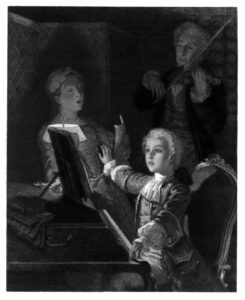
Mozart as a child rehearsing 1868. Source: iStock by Getty Images
THE TIMELY INTRODUCTION OF INOCULATION IN ENGLAND, USA AND EUROPE –
Fortunately for Mankind, knowledge of India’s Vedic method of inoculation passed on freely to other countries eventually helping save countless lives.
“Two observations in ancient times led to early attempts at immunization. ….. pockmarked persons never caught smallpox, and that individuals accidentally infected with smallpox by a scratch on the skin suffered a much less severe form of the disease. This knowledge led to the practice of inoculation with smallpox pus or scabs known as variolation [9].”
(Ref.11, 20).
“From the Far East the practice (of Vedic inoculation) spread to the Near or Middle East and here there enters on the scene one of the most remarkable individuals in the history of preventive medicine, Lady Mary Wortley Montagu, who was the wife of the British Ambassador to Turkey.”
“…..she learned of the practice of ‘variolation’, which was a well organized procedure in Constantinople at the time.” (Ref. 10).
“In 1714, the Royal Society of London received a letter from (Dr.) Emmanuel Timoni (physician affiliated to the British Embassy in Istanbul) describing the technique of variolation, which he had witnessed in Istanbul…….. It was the continued advocacy of the English aristocrat Lady Mary Wortley Montague (Figure 2) that was responsible for the introduction of variolation in England (10)……..
“ …. physicians soon began the variolation procedure on a massive scale……. variolation rapidly gained popularity among both aristocratic and common people in Europe” .
(Ref. 32)
THE TALE OF A THIRD YOUNG BOY WHO WAS INOCULATED…. AND WHO CHANGED THE WORLD
As mentioned in Part I of this issue,
“In 1757, a young boy in England by the name of Edward Jenner was inoculated. He suffered from the disease for an entire month. Even though he recovered, he was determined to find a better method of preventing smallpox.”
(Ref. 34a, 36a).
The use of INOCULATION, a protective method from VEDIC PHYSICIANS, doubtless unsophisticated, practised for over a thousand years (Ref. 34), thus helped spur the imagination and motivated Edward Jenner, considered today as the Father of the method of protective VACCINATION, not just of smallpox, but of all infectious diseases.
Jenner went on to study medicine , and
“After Jenner returned from medical school in London, a smallpox epidemic struck his home town of Berkeley, England. He advised the local cow workers to be inoculated. The farmers told him that cowpox prevented smallpox. ….. ”
(Ref. 34a).
In fact, a farmer called Benjamin Jesty had established this fact twenty years earlier, but no further progress was made of this finding.
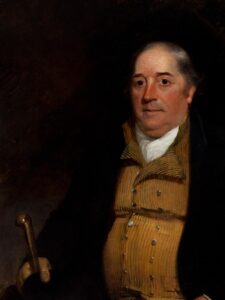
Benjamin Jesty is the first person recorded to have used the process of vaccination with cowpox matter in 1774 on his wife and sons. Source: Burrows Welcome Collection, Public Domain
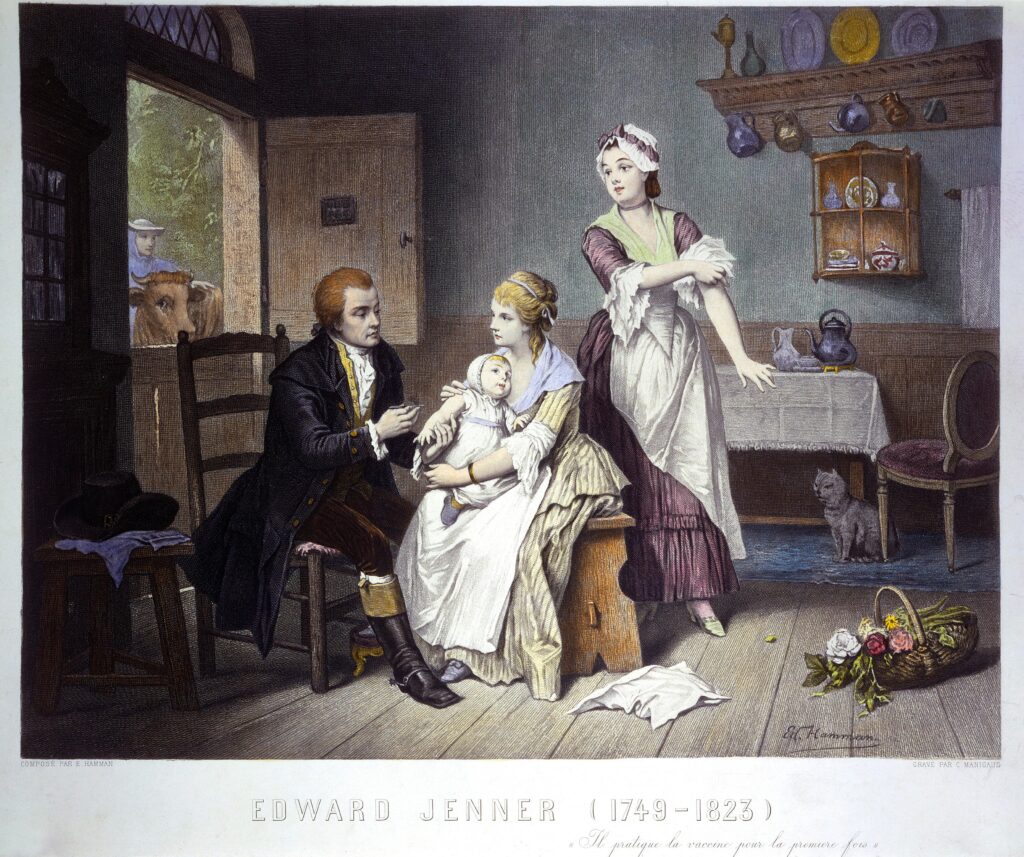
Jenner went on to confirm this for himself. On May 14th 1796, he injected a small boy James Phipps with cowpox material from the hand of a dairymaid, Sarah Nelmes, contracted from an infected cow “Blossom”; the boy suffered a mild response with fever and a few pocks appearing and subsiding without scars. Later when challenged with an inoculation of smallpox the boy had no reaction whatsoever, marking the first step towards a new safer method to prevent smallpox infection for humanity. (Ref. 4).
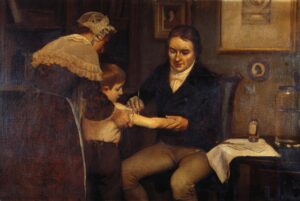
Edward Jenner performing the first vaccination on a child, James Phipps, 1796. Source: Burrows Welcome Collection, Public Domain
“….(Jenner) studied cowpox further, presenting a paper on it to his local medical society.” (Ref. 34a). The Royal Society rejected Jenner’s report, and even advised him to stop his vaccinations !!!
Fortunately for Humanity, Jenner did not take this advice. Jenner wrote a pamphlet on 22 cases that he had personally vaccinated, and distributed this at his own cost to medical colleagues.
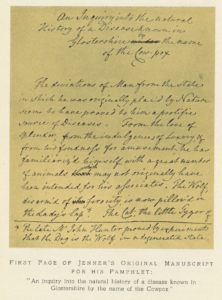
Source: Burrows Welcome Collection, Public Domain
Source: Burrows Welcome Collection, Public Domain
On the advice of his teacher John Hunter (renowned surgeon), Jenner maintained a meticulous record of the cases he vaccinated with cowpox, and eventually this case diary formed the base document with which Jenner convinced his medical colleagues about the effectiveness and benefits of vaccination.
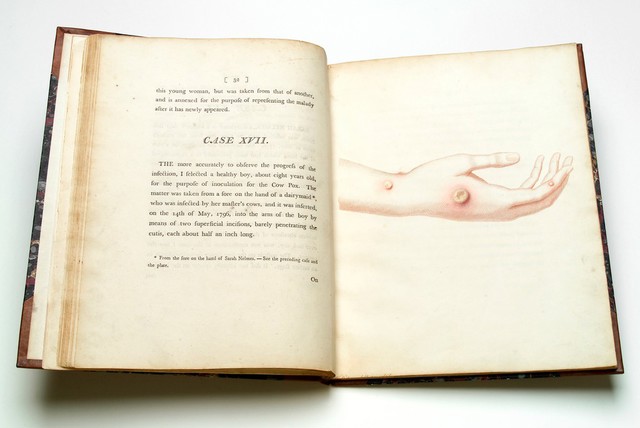
Jenner’s Case Diary “An Inquiry into the Causes and Effects of the Variolae Vaccinae; A Disease discovered in some of the Western Counties in England, particularly Gloucestershire, and known by the name of the Cowpox, 1798. Source: Burrows Welcome Collection, Public Domain
Jenner continued to provide vaccination free to all his poor patients, and often incurred expenses himself. His vaccine was championed by many medical practitioners, and eventually the British Parliament acknowledged his contributions and awarded him generous funds.
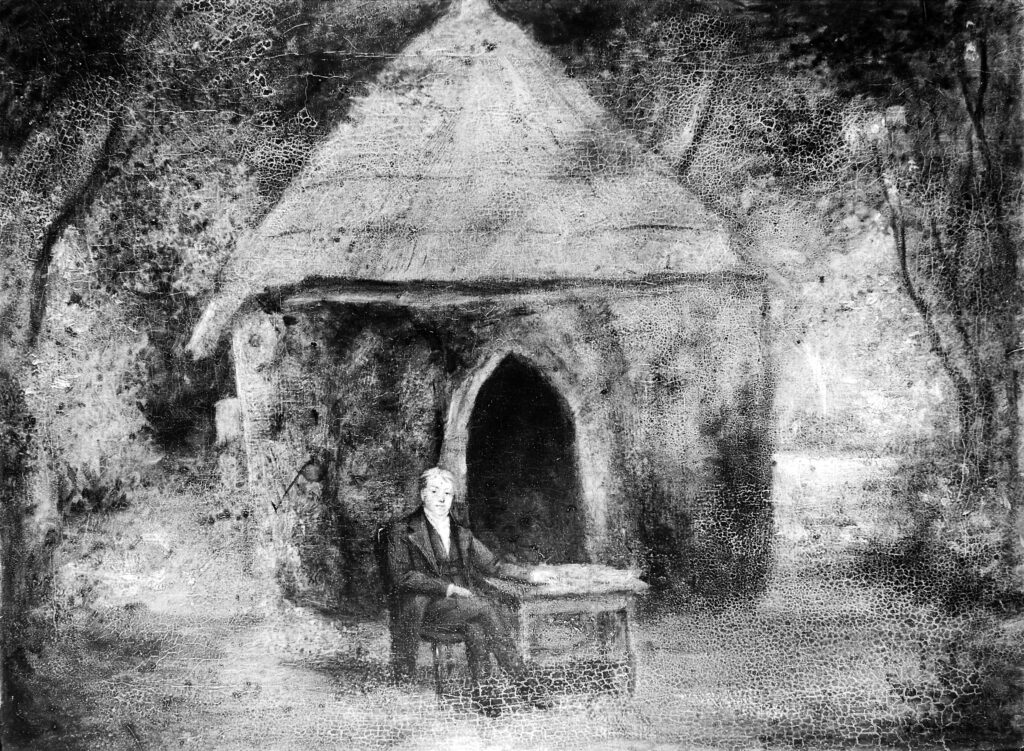
Representation of Edward Jenner’s Temple of Vaccination at his home at Gloucestershire. Source: Burrows Welcome Collection, Public Domain
AN AMERICAN PRESIDENT’S TRIBUTE TO JENNER….. MANKIND CAN NEVER FORGET THAT YOU HAVE LIVED
“President Thomas Jefferson, ………… wrote Edward Jenner in 1806: “You have erased from the calendar of human afflictions one of its greatest. Yours is the comfortable reflection that mankind can never forget that you have lived. Future nations will know by history only that the loathsome smallpox has existed.”
(Ref. 16)
AND A FRENCH EMPEROR’S GRATITUDE … I CANNOT REFUSE JENNER ANYTHING
“In 1813, Napoleon was reluctant to pardon Captain Millman, a relative of Jenner’s who had fallen captive (in battle). When told who had made the request for the soldier’s release, Napoleon exclaimed, “Ah, c’est Jenner, je ne puis rien refuser a Jenner!” [Ah, it is Jenner, I cannot refuse Jenner anything!] (77).”
(Ref. 2).
MEANWHILE, INOCULATION CONTINUED BACK HOME IN INDIA….. QUITE EFFECTIVELY
Historians have recorded that inoculation was practiced in India to protect communities when an epidemic of smallpox threatened them. Brahmin inoculators undertook the task of going door to door in affected villages and inoculating the people who wished to be inoculated. (Ref. 15).
Inoculators were called “tikadaars” and the inoculation itself was called “providing a tikaah”. This was routinely done in the East, North and a few districts of South India upto the 18th century.
“it used variolated matter only from the pustule of previously inoculated persons, thus greatly increasing the chance for a mild case to occur in the inoculee. This method seems to have been current only in India”
“Although variolation had been known for centuries in India, it was nowhere practiced on a large enough scale to be of importance as a public health measure.”
(Ref. 13)
“How effective was variolation as a method of disease control? According to the method employed the risk of death from variolation varied between 1 to 3 per 100; this contrasts
with a death rate in naturally acquired variola major during epidemic phases ranging between 1 in 2 to 1 in 6 persons. There is no question that variolation was a most impressive discovery.”
“……. Razzell’s evidence for 18th century England and the evidence for 18th and early 19th century India shows that variolation when practiced fairly extensively in the population was an impressively effective method of controlling the disease. A survey of Bengali villagers in 1850 reveals that 81% of the population had been variolated (Greenough 1980:347).”
(Ref. 25)
INOCULATION vs VACCINATION
Vaccination derived its name from the origins in the use of cowpox material; “vacca” means cow. When immunity is generated from a related variety of pox which is NOT smallpox itself, but protects against smallpox, this immunity DOES NOT LAST for a LIFETIME. It needs to be renewed by repeating the immunization process after about 10 years.
Inoculation has the benefit of conferring immunity to smallpox infection for the entire lifetime, exactly as the benefit conferred by natural infection on a patient.
Inoculation however, has an inherent risk of serious illness, and even death, causing upto around 3.0 % mortality. This is MUCH LOWER than the 30-90% mortality of the natural illness itself, and hence, in pre-vaccination days it was considered to be acceptable to contracting smallpox itself.
“It (variolation) protected individuals, but its spread from inoculated persons contributed to outbreaks of smallpox.”(Ref. 13).
“An undeniable conclusion of inoculation is that the virus was unwittingly kept alive through repeated usage in humans, and a reservoir of infection was thus created.”(Ref. 28a).
However, this was overcome by isolation of inoculated subjects and by ensuring they were nursed by people who had already been infected and/or inoculated, and had recovered. The young Jenner was nursed in an “inoculation stable”(Ref. 36a)
WHAT DID THE METHOD OF INOCULATION AGAINST SMALLPOX ACHIEVE?
Keeping in mind that inoculation did pose a small risk of infection severe enough to kill, proponents of the method sought clarity on its usefulness in control of the disease through the use of mathematics. British Scientist James Jurin presented his analysis in 1723 to the Royal Society.
“Jurin calculated that while the chance of dying from natural smallpox was between two in 17 and two in 11, the risk of dying from smallpox received through inoculation was one in 50…. (over 4 subsequent years) …. “it was shown that inoculation had a fatality rate eight to 10 times less than contracting smallpox naturally.”
“……… physicist and mathematician Daniel Bernoulli similarly sought to examine inoculation from a mathematical point of view.
(Ref. 5a).
“With simple calculations using life tables, and assumed probabilities for the risk of catching smallpox and its case fatality, he concluded that “by adopting universal inoculation against smallpox, France would gain 25 000 additional useful ‘Civil Lives’ which would benefit the state and society”. This analysis was published in 1766(2).”
(Ref. 37a).
FINALLY …… THE WORLD ADOPTS VACCINATION, AND SMALLPOX IS ERADICATED GLOBALLY.
‘In 1801, only five years after his epochal discovery of the utility and safety of cowpox vaccination as a preventive against smallpox, Jenner himself predicted that “the annihilation of smallpox-the most dreadful scourge of the human race-will be the final result of this practice.” Even so, mankind still had a lot to learn about smallpox and its prevention.”
(Ref. 16).
Thus far, both Vedic physicians’ method of inoculation, and Jenner’s method of a safe and almost non-toxic method of vaccination had been able to tackle smallpox only on a community level, and to protect small communities and villages from smallpox during epidemics.
There was no capability to tackle the disease on a national level, let alone dare to attempt eradication on a global scale.
PAINSTAKING STEPWISE IMPROVEMENTS IN VACCINE PRODUCTION and DELIVERY
INCREDIBLE TRANSNATIONAL EFFORTS … WHEN SWORN ENEMIES JOINED HANDS
“Following Jenner’s discovery, it remained for Negri of Naples to show how the vaccine could be mass produced from inoculated cattle in 1842; for Britain’s Monckton Copeman to demonstrate the germicidal effect of adding glycerine to smallpox vaccine in 1891; and for Dutch and French researchers to develop a heat-resistant dried vaccine for use in their colonies in the 1920’s. The ultimate improved method of freeze-drying vaccine was developed at the Michigan State laboratories in 1949, field tested in Peru, and adapted to commercial production at England’s Lister Institute in 1954.
Two final technological advancements which aided eradication were development of the jet injector by the US Army and its later adaptation for use to inject smallpox vaccine intradermally in the early 1960’s, and development of the bifurcated needle by Wyeth Laboratories during the eradication campaign in 1968.” (Ref. 16).
It would be almost 200 years after Jenner developed the method of vaccination, that the World Health Organisation, WHO, in 1959, launched an aggressive campaign for the eradication of smallpox all over the world.
Scientists from the Cold War antagonists, Russia and the United States, worked hard together sharing information, and putting in efforts to overcome the SPECKLED MONSTER.
“Smallpox vaccinations became routine for schoolchildren, mass production of the vaccine being now possible, and by 1971 these vaccinations were no longer required in USA and UK, and were discontinued.”
(Ref.30)
HOW INDIA WAS FREED OF SMALLPOX…. A GIGANTIC EFFORT
“The strategy of “surveillance-containment” …………. health workers visited every one of the country’s 100 million households. ……. some thirty-three thousand district health personnel and more than 100,000 additional field workers conducted house-to-house searches in a total of 575,721 villages and 2,641 cities. (Tucker 108).
……. It is estimated that each nationwide search of smallpox consumed about eight tons of paper forms. (Tucker 108)”
“In May 1975, the very last case of smallpox was found in India.”
“The International Commission finally certified that India was free of Smallpox” (in 1977).
(Ref. 29a).
“Humanity had reached one of its finest hours. In the relatively short span of less than 200 years, the world was successful at controlling and eventually eliminating one of the biggest infectious disease threats humankind had ever seen.”
(Ref.30)
In 1979, the WHO’s Global Commission for Certification of Smallpox Eradication declared the WORLD SMALLPOX FREE.
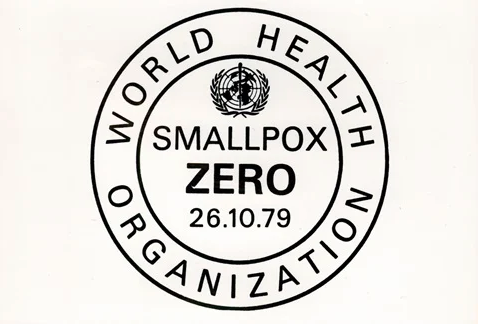
WHO Certification Logo of the eradication of Smallpox, 26th October 1979. Public Domain.
JENNER’S DISCOVERY PLACED IN PERSPECTIVE
“……following the discovery of Dr Jenner’s vaccine, eradication was achieved through prevention, as he himself predicted. Bolstered by efforts united around the world, Jenner’s concept survived to defeat a historic scourge.
(Ref. 38).
“……………(often, scientific) developments represent the culmination of decades, if not centuries of work, conducted by thousands of persons…. The breakthrough is really the latest in a series of small incremental advances, perhaps the one that has finally reached clinical relevance….”
“The history of smallpox prevention did not begin or end with Jenner ……. Effective inoculation had gone on for centuries before his time….
“Is Edward Jenner deservedly a hero? People had been injecting smallpox infected matter subcutaneously to prevent disease for centuries before Jenner’s time….. The recognition of these facts should not diminish our view of Jenner’s accomplishments. His relentless promotion of vaccination changed the way that medicine was practiced…. Jenner’s contribution was indeed a vital step towards the elimination of smallpox. However, it is equally clear that his work was one of countless vital steps and not the single crucial one. Yes, Edward Jenner is indeed a hero, yet, he is one of many.” (Ref. 14a).
“Jenner’s great merit was perseverance and the ability tirelessly to publicize his ideas, in spite of discouraging setbacks.”
(Ref. 37).
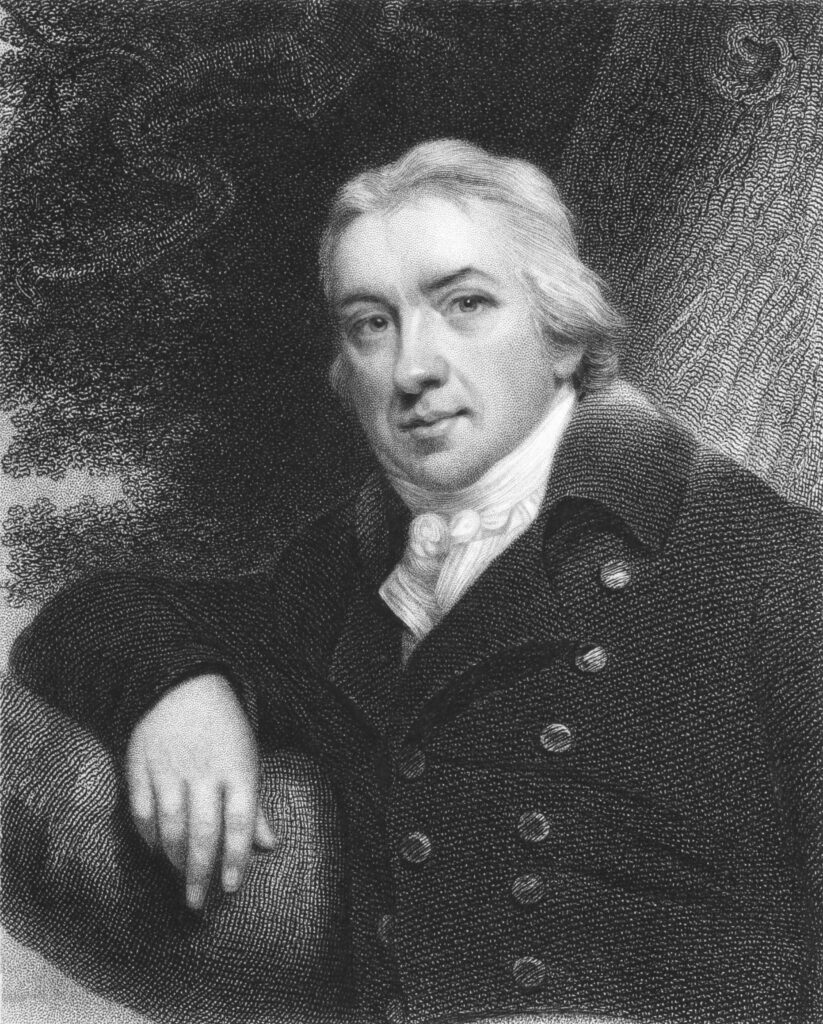
Edward Jenner Source: iStock by Getty Images
CONCLUDING REMARKS:
Starting in Ancient India with crude inoculations by Vedic Physicians centuries ago, proven to have saved countless lives, and culminating in a massive global implementation of mass vaccinations as a concerted Public Health measure using sophisticated product and techniques, the world today is FINALLY free of the worst killer virus known to Mankind throughout History.
It took the sequential and collective efforts of thousands of devoted and committed people themselves unseen and unsung. Each contributed a small piece to an awesome jigsaw puzzle to be solved, with only A SINGLE outcome to be considered – FREEDOM FROM DISEASE.
DEDICATION:
PART 1 of ISSUE 2, VOLUME 1, IS DEDICATED TO
All the unknown AND known heroes who helped CONQUER THE SPECKLED MONSTER VIRUS – SMALLPOX and to ERADICATE IT FROM THE WORLD.
The Ancient Indian Vedic sages, the thinkers, the truth seekers, African, Arabic and Chinese physicians, Turkish inoculators, Indian “tikadaars”, European physicians, Dr. Emmanuel Timoni, Lady Montagu, Benjamin Jesty, Dr. Edward Jenner, The WHO, Governmental Heads backing the effort, all the medical, scientific and philanthrophic champions of vaccination, the Vaccine production and delivery researchers, virologists, manufacturing experts, cold chain specialists, and the social workers who delivered the vaccine following door to door strategy, ALL UNSEEN UNSUNG HEROES who DECIMATED THE SPECKLED MONSTER FOREVER.
“Full many a gem of purest ray serene,
The dark unfathomed caves of ocean bear.
Full many a flower is born to blush unseen,
And waste it’s sweetness on the desert air.”
Thomas Gray.. ELEGY WRITTEN IN A COUNTRY CHURCHYARD
APPRECIATION: In personal appreciation of my good friend, late Dr. K.K.Haji, (physician and intellectual extraordinaire) for the stimulating discussions that we had on the origins of small pox inoculation in Ancient India – it was because I had to work so hard to convince him, that I realized how little Vedic Indian contribution was appreciated generally. Thank you, Khalid, for unwittingly planting the seed of this blog in my head.
ACKNOWLEDGEMENT: In grateful recognition of the dogged persuasion used by my daughter Neha Sharma, who coaxed me to write when my interest flagged, and who is the architect of the blog as it appears before you, uploading it and maintaining it with perseverance and commitment. Thank you, sweetheart; without your efforts, this blog could not have been. Introducing my daughter Neha Sharma
Neha’s Profile

Neha was born in an Entrepreneurial Family with an ancestry rooted in the love of Ancient India. Her love of Bharatnatyam made her pursue this ancient Indian classical dance at the Nritya-Prabha Dance Academy with her Guru’s Shailaja and Ambika Menon.
Brought up on the belief that “India is a Land of Seekers” compounded with her Mother’s passion to write and to give back to India; a desire was sparked in Neha during her school years to participate in her Mother’s Quest that lingered like a burning ember for years to come.
These embers were flamed and extended to her profession where a subject named “Indian Ethics and Business Ethics” fuelled her passion to find her purpose in guiding Indian Corporates and Conglomerates to chart their path to Quality and Business Excellence.
Fast-Forward to 2023, in her personal capacity, Neha serves as the website designer and administrator of her Mother’s Blog Vedic Treasures: India’s Gifts to the World. And in her professional capacity, Neha is an Entrepreneur who guides organizations to chart their path to Innovation and Business Excellence.
With 10+ years of work experience in Process Maturity Benchmarking, Process Excellence and Business Excellence, Neha has led 55+ operational and human excellence initiatives using CMMI-Development and Services, People Capability Maturity Model (PCMM) and ISO 9001:2015 culminating in 440+ Auditing Hours, 100+ Trainer Hours with 200+ participants trained for over 40 clients spanning 19 Industries.
As Founder and CEO of Beacon Solutions, she serves as a Corporate Trainer, Auditor, Consultant and a CII-Assessor for CII-EXIM Bank Award [EFQM, Malcolm Baldrige], CII-Customer Obsession Awards and CII-National HR Excellence Awards.
REFERENCES for PARTS I and II
- 1. Agarwal, Jyotsna and Sahota, Poonam Bir Kaur, “ Brahmavihara meditation & its potential benefits for a harmonious workplace”, 2020, Publ: mindrxiv.org ( a service of the Mind Life Institute).
- 2. Barquet, Nicolau and Pere Domingo, “Smallpox: The triumph over the most terrible of the Ministers of Death”, Ann Intern Med, Vol 127 (No.8 Part 1), Oct 1997, pages 635-642.
- 3. Behbehani, Abbas, “The smallpox story: Life and death of an old disease”, MICROBIOLOGICAL REVIEWS, Vol 47, No. 4, Dec. 1983, p. 455-509
- 4. Berche, Patrick “Life and death of smallpox”, 2022, Elsevier, Version of Record: https://www.sciencedirect.com/science/article/pii/S0755498222000100, Manuscript_8bc77f1f21cfc0699e9e724d7b3d614f. This manuscript is made available under the Elsevier user license https://www.elsevier.com/open-access/userlicense/1.0/
- 5. Britannica: Hinduism, The Upanishads https://www.britannica.com/topic/Hinduism/The-Upanishads
- 5a. Chen, Allison, “Bernoulli, Jurin, and the Math behind Smallpox”, The Johns Hopkins
- Newsletter, May 24th, 2023.Available online at https://www.jhunewsletter.com/article/2018/12/bernoulli-jurin-and-the-math-behind-smallpox
- 6. Deogade M.S. and Khetamakka S.R.P., “Krumi,(microorganisms) in Ayurveda – A critical review”, International Journal of Ayurvedic Medicine, 2019, 10(4), 297-300, Published online in http://ijam. co. in.
- 7. Devasagayam T.P.A.,and Sainis K.B., “Immune system and antioxidants, especially those derived from Insian medicinal plants”, Indian Journal of Experimental Biology, 2002, Vol. 40, pg 639-655.
- 8. OMITTED IN EDITING
- 9. OMITTED IN EDITING
- 10. Dudgeon J.A., Journal of the Royal Society of Medicine, Vol 73: 581- 586, 1980.
- 11. Ellner P.D., “Smallpox: Gone but not forgotten”, Infection 26 (1998) No. 5 9 MMV Medizin Verlag GmbH Munchen. Munchen 1998, p 263-269.
- 12. OMITTED IN EDITING
- 13. Fenner F, Henderson DA, Arita I, Jezek Z, Ladnyi ID, “The history of smallpox and its spread around the world”, Chapter 5, Smallpox and its Eradication World Health Organization, Geneva, 1988
- 14. Geng , Caitlin, “Smallpox: History, cause, vaccine, and does it still exist?” — MEDICAL NEWS TODAY, https://www.medicalnewstoday.com/articles/smallpox, Medically reviewed by Nuwan Gunawardhana, MD, Last medically reviewed on February 27, 2022.
- 14a. Gross, Cary P, and Sepkowitz, Kent A., “ The Myth of The Medical Breakthrough: Smallpox, Vaccination, and Jenner Reconsidered”, International Journal of Infectious Diseases, Vol. 3, No. 1, July-Sept 1998, page 54-60
- 15. What HINDUONLINE: MEDICAL SCIENCE, http://hinduonline.co/FactsAboutHinduism/MedicalScience.html
- 16. Hopkins, Donald R., “Smallpox : Ten years gone.” American Journal of Public Health, Vol 78 (12), 1988, pg 1589 – 1595.
- 17. Kak Subhash, ‘A Brief History of Indian Science’, 2002, ece.lsu.edu.pdf
- 18. OMITTED IN EDITING
- 19. Kalinin A. G. and Postoev V.A., “History of Medicine and Public Health, Training Manual”, Arkhangelsk Northern State Medical University, 2021, Ministry of Health, RUSSIA.
- 20. Kayser, Veysel and Ramzan, Iqbal (2021) Vaccines and vaccination: history and emerging issues, Human Vaccines & Immunotherapeutics, 17:12, 5255-5268, DOI: 10.1080/21645515.2021.1977057
- 21. OMITTED IN EDITING
- 22. Lahariya C., “A brief history of vaccines and vaccination in India”, Indian J.Med.Res., 2014, Vol. 139, pg 491- 511.
- 23. Leigh Lex, “Just a poke; The origins of inoculation : Ancient Origins”, https://www.ancient-origins.net/history-ancient-traditions/inoculation-0016692#google_vignette, UPDATED 27 APRIL, 2022.
- 23a. Liester, Mitchell, B.: “A review of the use of persuasion and coercion to overcome COVID-19 vaccine hesitancy,”, Journal of Peer Scientist 4(2): p 1-29, e1000037, Dec 27, 2021.
- 24. LYONS A.S., AND PETRUCELLI R.J IInd., “MEDICINE, AN ILLUSTRATED HISTORY”, Ed.: Walton Rawes, Publ.: HARRY N. ABRAMS Inc, NEW YORK, 1978: (Personal library).
- 25. Marglin, F.A., “Smallpox in two systems of knowledge”, 1987, Prepared for the UNU/WIDER Planning Meeting on Systems of Knowledge as Systems of Domination 21-23 July 1987.
- 26. Merriam Webster Dictionary online, “Virus”, https://www.merriam-webster.com/dictionary/virus
- 27. Nene Y.L, “A glimpse at viral diseases in the ancient period”, Asian Agri-History, Vol 11, (1), 2007, 33-46.
- 28. Norrie, Phillip, “A history of disease in Ancient times – more lethal than war”, Publ.: Palgrave Macmillan, 2016.
- 28a. Ochman, Sophie and Roser, Max,” Smallpox”, Published online at OurWorldInData.org. Retrieved from ‘https://ourworldindata.org/smallpox’[Online Resource]
- 29. Ogden, Horace 1987, “CDC and the smallpox crusade”. Publ.: US Department of Health Services, Public Health Services, Center for Disease Control, HHS Publication No. CDC 87-8400
- 29a. Online Exhibit, Michigan University Library, “ Smallpox Eradication in India, 1972-1977 | India Engages the Pandemic” · Online Exhibit: https://apps.lib.umich.edu/online-exhibits/exhibits/show/smallpox-eradication- india/indian-engages-pandemic, Page 5 of 12
- 30. Payette P. J. and Davis H.L., “History of vaccines and positioning of current trends”, Current Drug Targets – Infectious Disorders, 2001, 1, 241-247
- 31. Piper, Kelsey – “Smallpox used to kill millions of people every year”, VOX, May 8, 2022. https://www.vox.com/future-perfect/21493812/smallpox-eradication-vaccines-infectious-disease-covid-19
- 32.Reidel, Stefan, “Edward Jenner and the history of smallpox and vaccination”, Baylor University Medical Center Proceedings, 2005, pg 21-25.
- 33. Subbarayappa B.V., “The roots of ancient medicine: an historical outline”, J.BioSci., Vol 26, No. 2, p 135-144, June 2001.
- 33a. “The life and death of smallpox”, online https://assets.cambridge.org/052184/5424/excerpt/0521845424_excerpt.pdf
- 34.THE SCIENCE MUSEUM, “Smallpox and the story of vaccination”, 25 April 2019, https://www.sciencemuseum.org.uk/objects-and-stories/medicine/smallpox-and-story-vaccination
- 34a.The School Wikipedia collection, 2007: SMALLPOX: https://www.cs.mcgill.ca/~rwest/wikispeedia/wpcd/wp/s/Smallpox.htm
- 35. Udwadia F.E., ‘Man and Medicine – A history’, Chapter 42, “Public Health, Jenner, and the discovery of vaccination”, Publ.: Oxford University Press, 4th impression, 2010, New Delhi.
- 36. Ward, William “A View of the History, Literature, and Mythology of the Hindoos” – volume II p 1817-1822, 3rd Ed. Publ B. R. Publ, New Delhi, Reprinted 1985).”
- 36a. Wellcome, Henry, “The history of inoculation and vaccination for the prevention and treatment of disease”, Lecture Memoranda A.M.A. meetings, Minneapolis, 1913,Burroughs Wellcome, London. (PUBLIC DOMAIN)
- 36b. Wesenberg, Karen, “Smallpox: Disease and Vaccine resurfacing concerns”, M.Sc. STATISTICS Project, April 25, 2003, Montana State University.
- 37. Wilkinson, Lise “The development of the virus concept as reflected in corpora of studies on individual pathogens* 5. Smallpox and the evolution of ideas on acute (viral) infections”, Medical History, 1979, 23: 1-28.
- 37a. Wilson, David P., “Just a little Analysis….”, Journal and Proceedings of the Royal Society of New South Wales, vol. 147, nos. 453 & 454, pp. 91-93. ISSN 0035-9173/14/020091-3.
- 38. WHO, “The History of smallpox vaccine”, https://www.who.int/news-room/spotlight/history-of-vaccination/history-of-smallpox-vaccination

Arun Nanivadekar
A highly readable accout of how several individuals — with different backgrounds, nationalities, faiths, and social status — contributed their might to achieve a unifying goal: to rid the human race of a disfiguring and devastating scourge. There is much more to learn from this story, especially how the lofty ideal वसुधैव कुटुंबकम (all the world is but one family) can be practised in real life.
S Chandrasekhar
These series are so thoroughly & painstakingly researched; and the writing style makes, what is a ‘heavy’ subject, readable & absorbing.
Please keep them coming !